

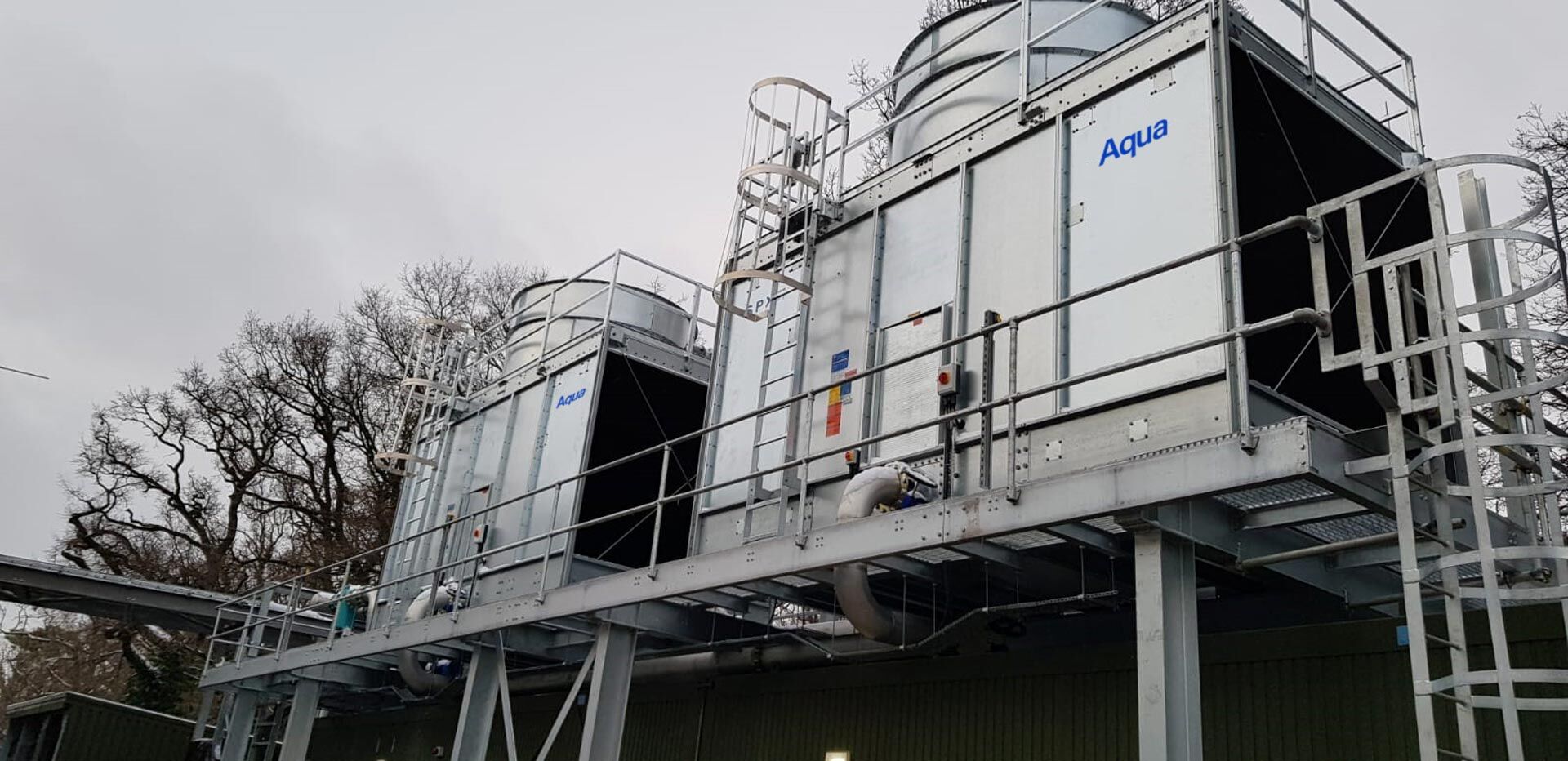
Cooling Towers
A comprehensive range of cooling towers for all types of application and requirements.
About Cooling Towers
Cooling towers offer unlimited thermal performance and unrivalled size.
The team at Aqua are equipped to design, supply and install a full range of cooling towers, whether they are a one-off unit or a multi-cell solution.
Aqua provides durable, flexible solutions for cooling towers in all settings. We can help you every step of the way from initial site visits, to cooling towers for sale, through to final installation. Your operating conditions will determine the design that we can create for you, but we’re confident we’ve got the best equipment solution for you.
Looking for help & advice on buying cooling towers?
Get in touch with the Aqua team to discuss with our specialist engineers today.
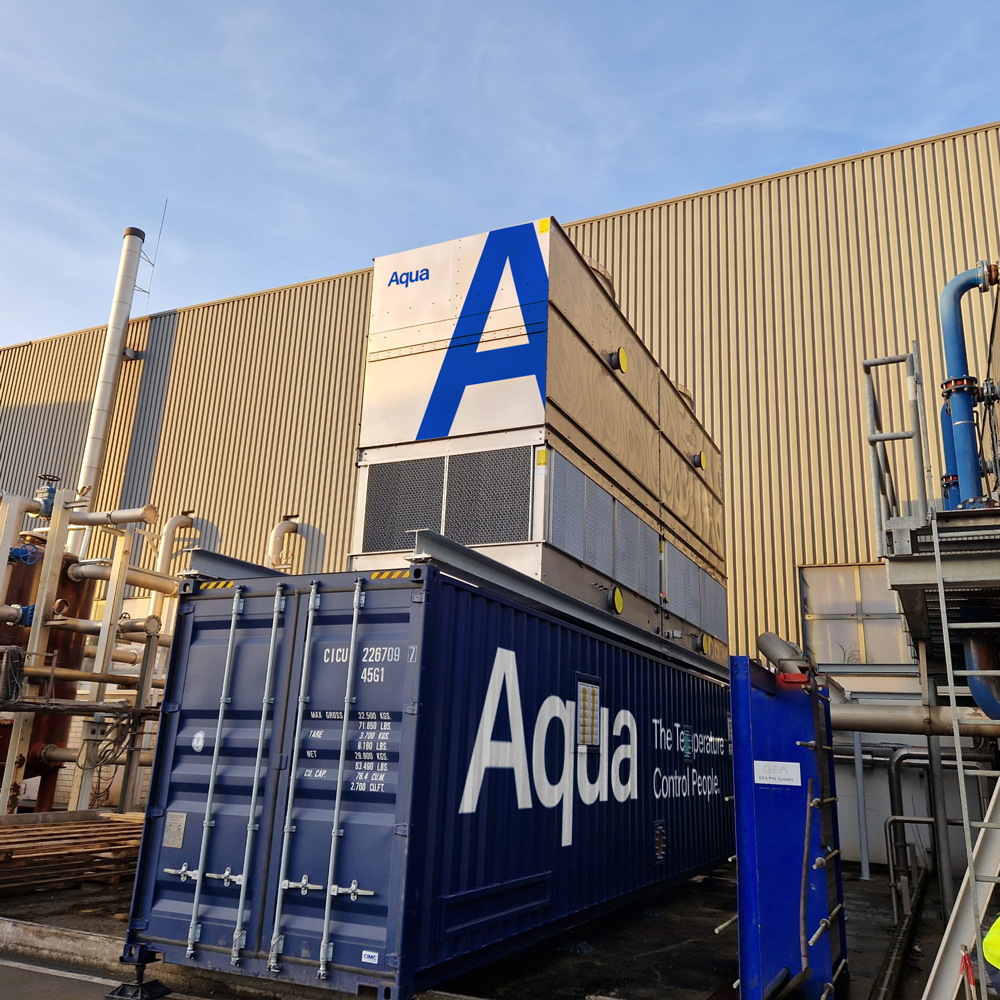

How do Cooling Towers work?
Cooling towers are effectively an organic heat exchanger. Warm or hot water from a process is cooled by passing it through the tower and back out again into the process.
A cooling tower enables the water to meet the air so that some of the water evaporates, lowering the overall water temperature.
Water is pumped – usually from either the basin of the tower or a sump tank below the cooling tower – through pipework to the process. This then returns to the cooling tower. The water is either sprayed by nozzles onto the fill media (counterflow) or returns to a top tank to gravity drain onto the fill media. This part of the process maximises air to water contact. The water flows over the fill media – or packing – meeting the air which is pulled (induced draft) or pushed through (forced draft) by a fan. This is referred to as evaporative cooling.
- Closed or Open Circuit Options
- Crossflow or Counterflow Options
- Crossflow or CForced Draft or Induced Draft Optionsounterflow Options
Cooling Tower Design Options
Aqua can supply cooling towers in a variety of materials, the most common being galvanised, stainless steel (304 or 316) and glass-reinforced plastic (GRP).
Galvanised stainless steel is the most popular option as it is the most cost-effective. Yet in environments that might be corrosive, we’d recommend stainless steel and glass-reinforced plastic cooling towers as a better option.
Aqua Cooling can also create low-profile cooling towers, which are best suited for city centres and rooftop applications. We can add centrifugal fans and silencers to reduce noise pollution wherever needed, because we don’t just sell cooling towers. Our expert team have the knowledge and skill to customise and build a cooling tower for any business in the UK.


Regular Maintenance Options
Water treatment & regular maintenance are key to keeping a cooling tower operating safely and efficiently. The correct treatment plan will protect against scale build up, corrosion, fouling and microbiological contamination, including Legionella. Please note, good care of a cooling tower is a legislative requirement. Our Service team can give you full support here – call 0333 004 4433 for free, no-obligation advice.
For more information on Aqua’s cooling towers or for help with product selection and technical support, call our Sales team on 0333 004 4433, chat with us on LiveChat or email sales@aquacooling.co.uk
Closed Circuit
A closed-circuit cooling tower includes a heat exchanger. The process water is separated from the ambient air so quality, and cleanliness is maintained. However, the heat exchanger adds to the size of the tower and can impact on cost.
Open Circuit
With open circuit, process water comes directly into contact with the external air stream. Disadvantages with the open design is that any contaminate within the air is passed into the water. Over time, because the water is treated and softened, these substances can build up within the system.


Crossflow
The air and water flow effectively cross each other, the air flows horizontally and the water drops vertically through the fill media. This enables variable flow in addition to lower water noise, when compared to a counterflow tower.
Counterflow
Air is pushed up vertically, counter to the water which is flowing downwards under gravity. Because it’s not possible to take advantage of the gravity flow, pressurised spray systems are used to spray the water onto the fill media. The spray system maximises heat transfer and this design is less likely to freeze in low ambient conditions. Counterflow towers tend to be more efficient and have smaller footprints, so better suited if space is restricted. This style of cooling tower often uses a more powerful fan, so sound attenuation packages can be added if the location is noise sensitive.
 Posted on Google
 Tomos Owens-Jones
Trustindex verifies that the original source of the review is Google.
Great customer support!Posted on Google Robert BrownCalled Aqua cooling out @ 4 pm Engineer Alan arrived at 7pm repaired the fault that was preventing the fridge units running on our 1000 tonne onion store. Really appreciated the excellent service. thankyou from E C Brown & SonsPosted on Google
 Mark CooperAfter working with Aqua Cooling over the past couple of weeks, I cannot recommend them enough. Connor has been the reliable engineer on site every day, nothing is too much trouble for him. Simon and Joe spent time with us as well for some of the jobs that required the extra hands. The whole job has gone smoothly with great communication from the engineers and Olivia (an absolute gem) in the office.Posted on Google
 Oliver StarrZeus Hydratech MD, Oliver Starr invited the Aqua Cooling team to collaborate with them to support one of the largest steel processing plants in the UK. The customers’ existing chiller units (fitted to large CNC equipment was old which meant parts and technical support was no longer available) Aqua Cooling were able to support us directly with the specification of suitable chillers from their range. I have been very impressed with their knowledge and service delivering such a large and technical order. Thanks to all at Aqua on behalf of Zeus Hydratech Limited. Oliver Starr | Zeus Hydratech Managing Director.Posted on Google
 Dawn WhiteGreat service with a speedy response. What more can you ask for? Thank you! On behalf of Turbex LtdPosted on Google
 Julie PinhorneVery good service. we are really pleased with the equipment on loan it looks nearly brand new. I had an issue at first with one of the machines not turning on, the customer service member of staff was immediately on the phone talking us through the issue which we resolved over the phone. I am Happy to use this company again. Reliable, friendly helpful staff.Posted on Google
 Robin HewittWe had a short term air-con need and Aqua were great. They responded to my enquiry almost immediately, and the hire was sorted within the hour. Even better, they delivered the units next day (and we're not local!) Aqua also extended my hire period with no dramas at all. Overall, truly excellent service

Download our Brochure

Frequently
asked questions
Cooling towers are used to reject heat from processes, HVAC systems, refrigeration plant and power generation. They work by evaporating a small portion of the circulating water into a moving air stream to cool the remainder. They are common in large manufacturing, chemical, pharmaceutical and data centre applications.
Cooling towers do present a legionella risk because they use warm water in contact with air which are conditions that can support bacterial growth. Managing this risk through a water treatment and inspection programme as required by ACOP L8 legislation is essential. Aqua can support you with a full water treatment and compliance service.
Cooling towers lose water through evaporation, drift, and blowdown. The exact usage depends on the size of the system and the heat load. Aqua can estimate water consumption for a proposed system and also advise on water saving measures such as drift eliminators and chemical programme optimisation.
The main alternatives are adiabatic coolers and dry air coolers. Both avoid the legionella management requirements of a cooling tower and use less water. However cooling towers can achieve lower fluid temperatures in high ambient conditions. Aqua will help you compare the options for your application.
Yes. Aqua’s Sales and Installation teams can design, supply, and install a new cooling tower as part of a complete temperature control system. We also offer ongoing service, water treatment, and maintenance support once your tower is operational.
Design & Installation
A Complete 360° Service including:
Design Consultancy
Free design consultancy including AutoCAD drawings, 3D modelling and energy calculations.
Project Management
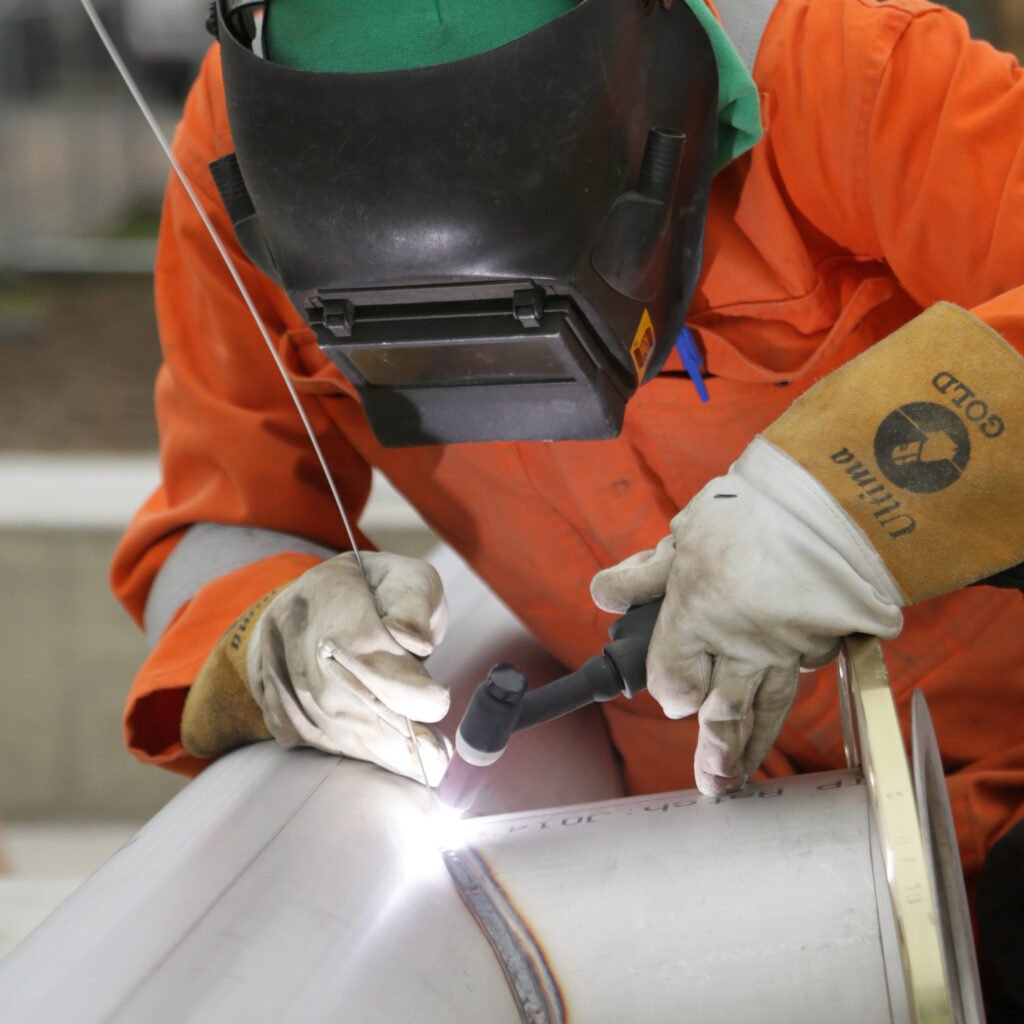
Encompassing civil works, offloading & positioning, pipework installation, mains power & cabling, commissioning and CDM compliance. All our Engineers are F-Gas accredited specialists and manage work according to agreed RAMS and site-specific H&S conditions.
Aftersales Support
Including preventative maintenance service plans to maximise efficiency and extend product lifespan. We can also help with spare parts, glycol, and water treatment.
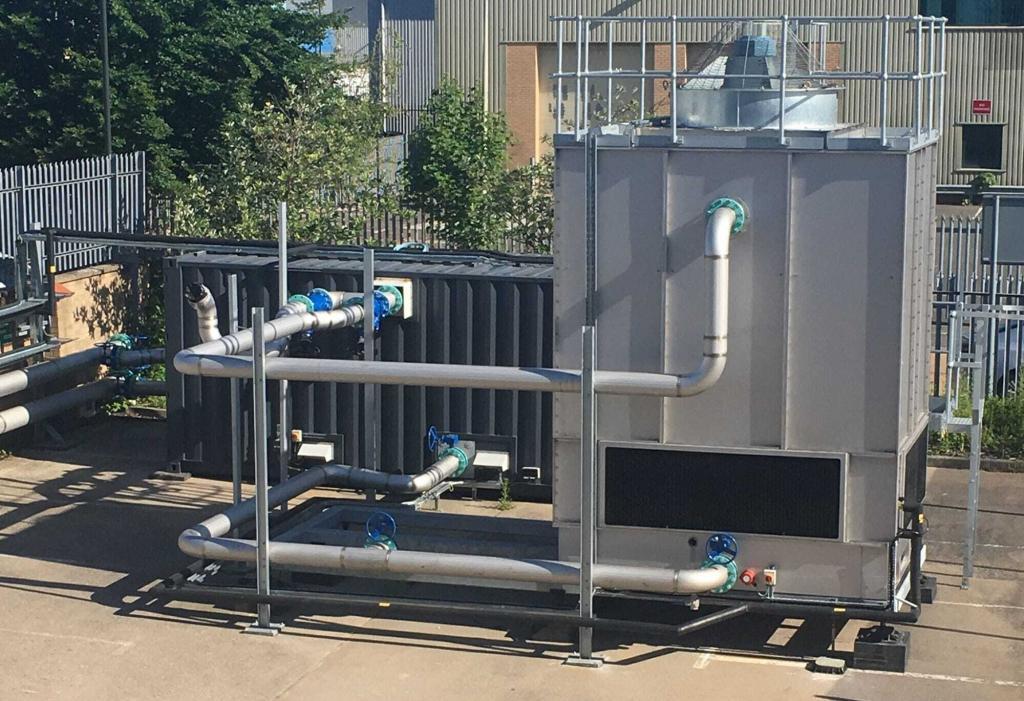
Keeping the World’s Data Cool
4D Data Centres is a UK-based colocation provider offering ultra-fast connectivity, cloud, and cyber solutions worldwide. Data centres power nearly all online technologies but require significant energy for both operation and cooling. When 4D acquired a Gatwick facility, Aqua upgraded its live chiller-based system with an intelligent, energy-efficient cooling solution—significantly reducing mechanical cooling needs and introducing fresh air free cooling.